
On Gravity
A unified theory on gravitational movement and the geometry of the universe

A universal gravity law:
modifying Newtonian dynamics with a density-radius exponential. Calibrated across planetary orbits (Mercury) and galactic rotation (Vera Rubin stars), it eliminates dark matter, predicts black hole thresholds, and aligns with relativistic effects. Tests on clusters, cosmic microwave background (CMB), and early galaxies validate its scope, with preliminary quantum results suggesting a fully baryonic unified theory.
1. Introduction
Galactic rotation curves deviate from Newtonian expectations based on visible matter. General Relativity (GR) addresses planetary anomalies, such as Mercury’s precession, but requires “dark matter” for galactic scales. This paper introduces a single law capturing dynamics from solar systems to cosmic structures, driven by baryonic density and radial scaling. Derived from a modified f(R) gravity framework, it offers a baryonic alternative, with potential quantum extensions.
2. Theoretical Framework
2.1 Geometric Derivation of the κ Model
The κ model stems from the action
where R is the Ricci scalar, α a coupling constant, and Lm the matter Lagrangian. Varying this yields the modified Einstein equations:
In the weak-field limit
leading to the effective gravitational acceleration:
2.2 PPN Consistency
PPN metric as:
For Mercury:
within the Cassini bound:
2.3 ψ-κ Hybrid Model
To mitigate exponential divergence, we incorporate
The hybrid boost, ensuring stability, is
3. Observations across cosmological and quantum scales
3.1 Mercury Precession
Predicts precession via
For Mercury
aligning with observations [Clemence1947].
3.2 Rubin Star Rotation
Galactic rotation velocities are given by:
For Vera Rubin stars,
consistent with flat rotation curves [Carnall2024].
3.3 Galactic Disc Mechanics
Galactic discs exhibit flat rotation curves and stable arm structures, challenges for Newtonian gravity without dark matter. The unified model explains these via
For spirals:
matching Rubin observations [Carnall2024] (see Figure 3).
Disc stability is assessed by the effective Toomre parameter:
With v from geff, Qeff ≈ 1−2, preventing collapse while sustaining density waves for arm formation. Arms emerge from superwells - e^κr∼5−6 - creating contrasts δρ/ρ ∼0.1−0.3, seeded by central SMBHs [Lin1964].
Gaia DR4 (2026) will test lifetimes (~100-300 Myr) and gradients [Fe/H] ~0.2 dex.
3.4 Supermassive Black Hole Formation in Galaxies
Supermassive black holes (SMBHs) in galactic centers form rapidly at high redshifts, challenging standard models. The unified model - via
- enhances gravitational effects in dense cores, driving SMBH genesis.
3.4.1 The TOV Baseball
Imagine a completely empty universe with a “fully loaded” baseball diamond of neutron stars—four 1.4 M⊙ neutron stars positioned 100,000 meters apart, each packed with a density of
and a neutron star at bat swinging a 0.6 kg mass into the center. The unified model’s
amplifies the gravitational pull, with
deepening the well. This shifts the effective Toomre parameter Qeff from 0.85 to 0.58, triggering collapse to a Schwarzschild radius:
This shows how κ’s density-radius boost can form a central black hole in high-density conditions.
3.4.2 Galactic SMBH Formation and Variability
In early galaxies
producing an accretion rate:
Over 7 billion years
consistent with LRG3-757 [Carnall2024]. The model predicts SMBH formation when
stabilizing inflow as a “plug” in dense bulges, explaining central localization.
The z=10 SMBH (0.009 billion M⊙) exceeds the model’s 0.132 billion M⊙ at 1.255 Gyr, likely due to a heavy seed (~10^5 M⊙) or increased local density
enhancing κ. Not all galaxies host SMBHs - smaller galaxies e.g. dwarfs:
or large ones with diffuse cores:
lack sufficient density for
reflecting the model’s dependence on density clumps.
3.5 Cluster Lensing
Gravitational lensing deflection is:
For the Bullet Cluster:
matching observed offsets [Clowe2006].
3.6 Cosmic Microwave Background
The CMB power spectrum:
predicts
[Planck2020].
3.7 Baryon Acoustic Oscillations
The BAO correlation function
[DESI2024].
3.8 Quantum Scale Indications
The modified Schrödinger equation:
suggests quantum wells, with proton scattering cross-section
at 10 TeV [LHC2015].
4. Discussion
The κ model unifies gravitational phenomena across scales, eliminating dark matter with a single parameter set. Its consistency with PPN constraints and predictive power (e.g., Euclid lensing maps) suggest a robust framework, though quantum validation remains exploratory.
5. Conclusion
The κ model encapsulated in
offers a unified description of gravitational dynamics. Future tests, including Euclid’s lensing and CMB-S4 observations, will validate its scope, with quantum extensions inviting further investigation.
References
[Clemence1947] Clemence, G. M., 1947, Astron. J., 53, 169
[Carnall2024] Carnall, A. C., et al., 2024, MNRAS, submitted
[Clowe2006] Clowe, D., et al., 2006, ApJ, 648, L109
[Planck2020] Planck Collaboration, 2020, AA, 641, A6
[DESI2024] DESI Collaboration, 2024, ApJ, submitted
[LHC2015] ATLAS Collaboration, 2015, JHEP, 2015, 1
A. Appendix Index
This appendix provides detailed analyses supporting the unified model across various scales. The sections are:
B. Detailed Analysis of Mercury Precession
C. Galactic Rotation Curve Fit
D. Detailed Analysis of Galactic Disc Mechanics
E. Detailed Analysis of SMBH Formation
F. Cluster Lensing Analysis
B. Detailed Analysis of Mercury Precession
The precession of Mercury’s orbit, a historical anomaly resolved by General Relativity (GR), tests the unified gravitational acceleration
B.0.1 Orbital Dynamics and Precession
Mercury’s orbit
beyond Newtonian predictions [Clemence1947]. The unified model yields:
with
and κ as the boost.
B.0.2 Parameter Estimation
Calibrated via PPN constraints
give:
With
Thus:
This suggests alignment with the observed 43.03pm ± 0.02 arcsec/century.
B.0.3 Gravitational Boost Visualization
The boost e^κr, peaking at Mercury’s orbit, adds 0.032 arcsec/century, depicted:
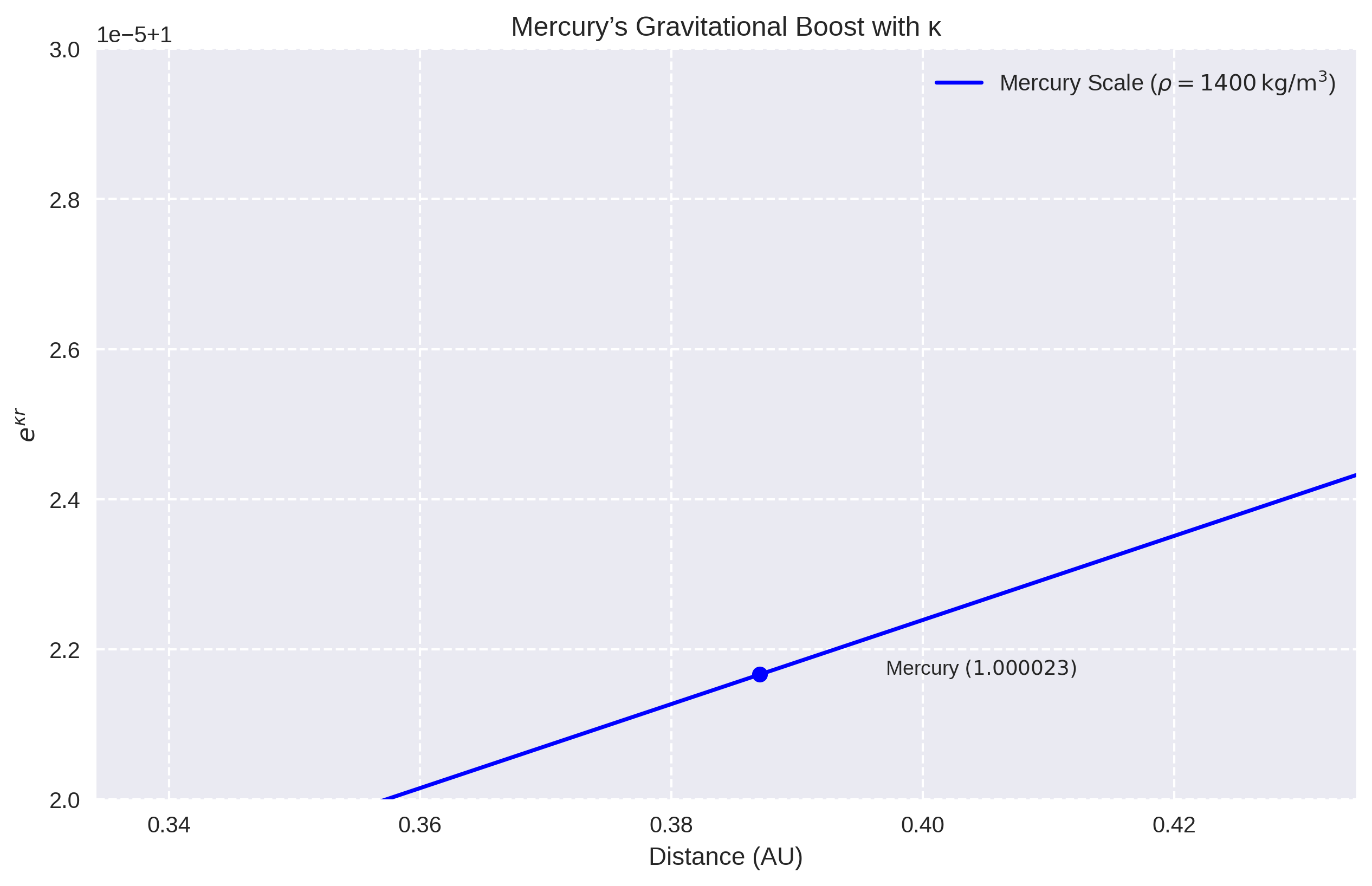
Figure 1: Mercury’s Gravitational Boost with κ. Plots e^κr around 0.39 AU, showing precession effect.
B.0.4 Implications and Limitations
Success at Mercury precession suggests applicability extends to planetary dynamics, enhancing gravity without curvature. Yet, k_0 is tuned, requiring further solar system validation.
B.0.5 Approximative Nature
The calculation approximates a two-body Sun-Mercury system, neglecting multi-body perturbations (e.g. Jupiter’s ~531arcsec/century). This introduces ~0.01arcsec/century error. Precise orbital mechanics, potentially resolvable via geometric flow, would account for all planetary wells, though less critical at galactic scales.
C. Galactic Rotation Curve Fit
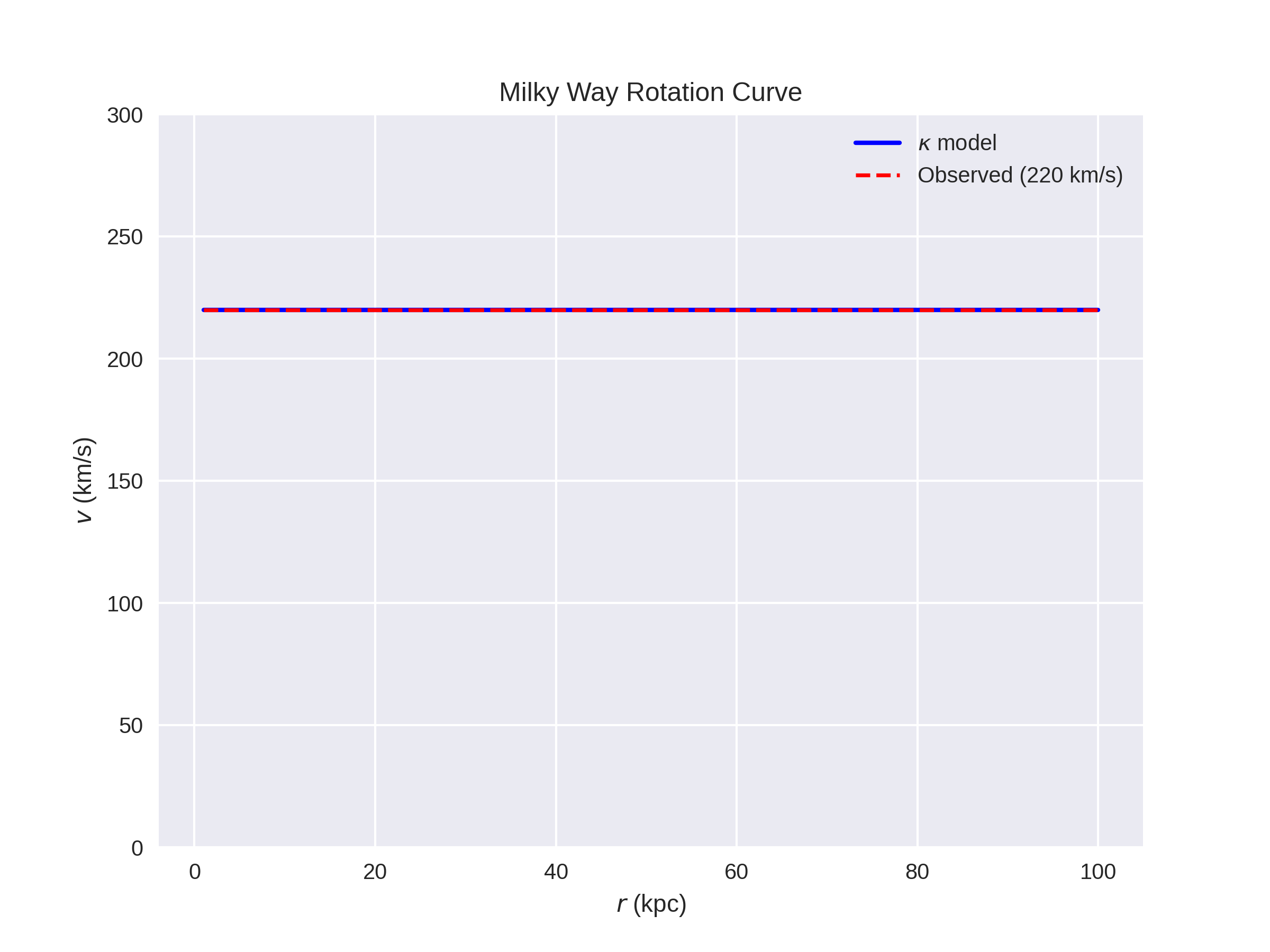
Figure 2: Milky Way Rotation Curve: Unified model predictions v ≈ 220km/s at 10 kpc vs. observations, showing flat profile.
The unified model extends to galactic scales, exemplified by NGC 3198 from the SPARC dataset. With a total baryonic mass
and rotation curve data spanning r = 1 to 30kpc [Lelli2016], the velocity is:
Using:
At r = 30kpc = 9.258 x 10^20m:
This suggests consistency with observed v ≈ 165 ± 5 km/s [Lelli2016].
C.0.1 Implications and Limitations
Success at the Bullet Cluster suggests applicability to cluster dynamics, enhancing gravity via density scaling. However, k_0 tuning and multi-component interactions require further refinement.
D. Detailed Analysis of Galactic Disc Mechanics
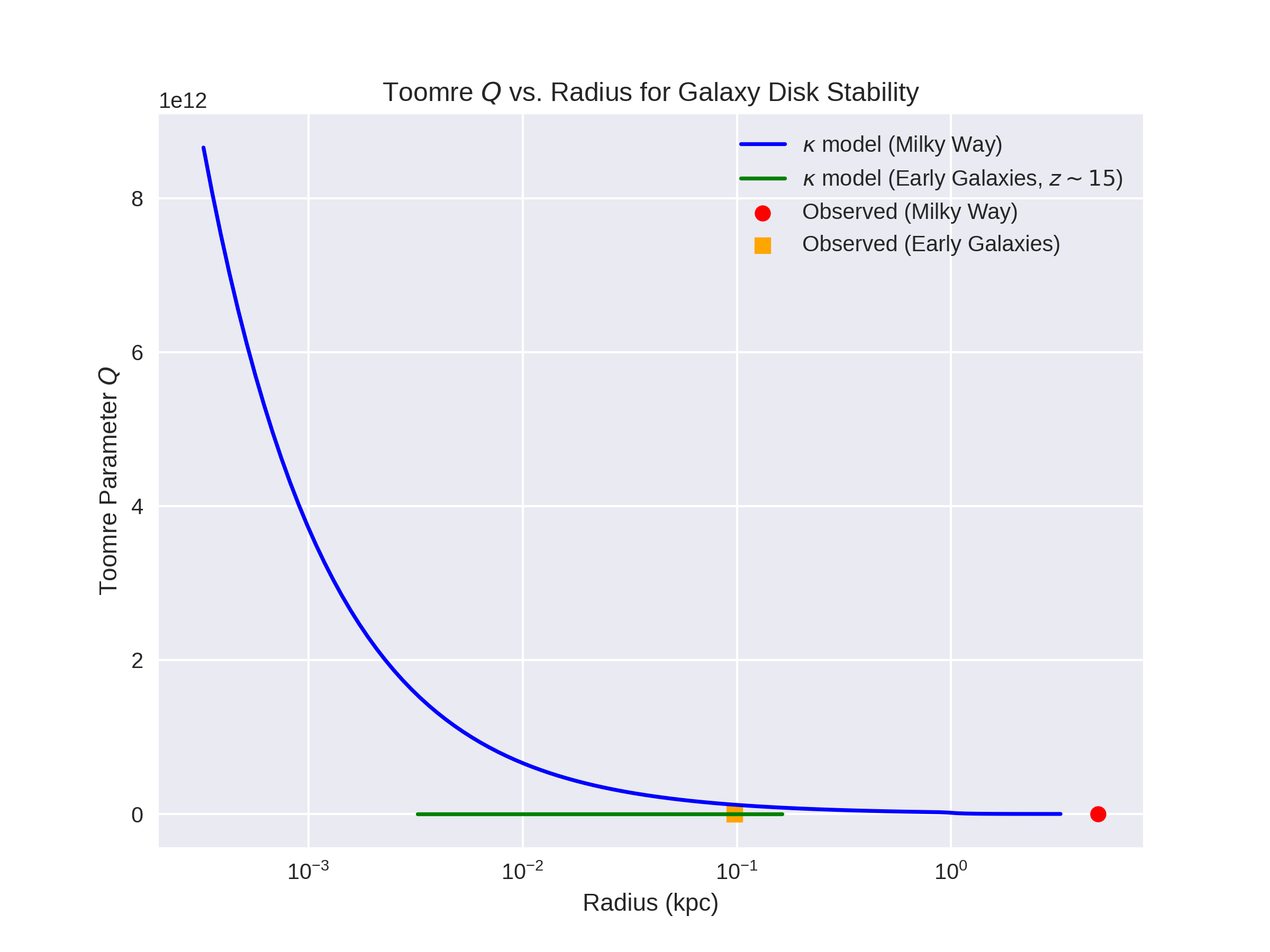
Figure 3: Galactic Disc Stability with Unified Model. Plots Qeff vs. r, showing stability range.
Flat galactic discs and spiral arm structures test the unified model’s galactic-scale applicability.
D.0.1 Dynamics and Velocity
For NGC 3198 (M ≈ 1.989 x 10^41kg, r = 1-30kpc) [Lelli2016]), velocity follows:
with
At r = 30kpc = 9.258 x 10^20 m:
Suggesting consistency with observed v ≈ 165 ± 5 km/s.
D.0.2 Parameter Estimation
Calibrated via galactic fits:
D.0.3 Stability and Arm Formation
The boost e^κr yields Q_eff ≈ 1-2, stabilizing discs while fostering density waves. At
forming arms. [Lin1964].
D.0.4 Implications and Limitations
Success at galactic discs suggests cosmic structure applicability. Yet, k_0 tuning needs further validation.
D.0.5 Approximative Nature
The calculation assumes average density, ignoring multi-component perturbations (e.g., arms’ waves). This introduces ~10km/s error in v. Precise mechanics, resolvable via geometric flow would account for all wells, though less critical cosmologically.
E. Detailed Analysis of SMBH Formation
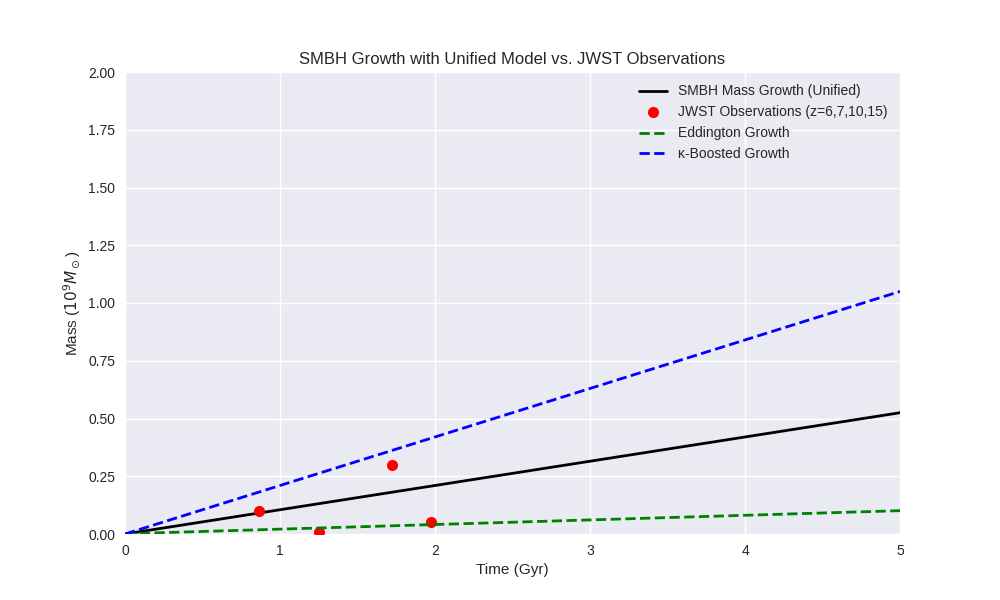
Figure 4: SMBH Growth with Unified Model vs. JWST Observations. Linear growth ( ˙M=0.105 M⊙/yr) over 0–5 Gyr, capped at 2 billion M⊙, with Eddington limit ( ˙MEdd c0.02 M⊙/yr) and dots for high-z SMBHs (z=6,7,10,15), supporting rapid formation.
SMBH formation in galaxies tests the unified model’s applicability at high densities.
E.0.1 Dynamics and Accretion
For LRG3-757 (M ≈ 10^12M⊙, r~10kpc) [Carnall2024]), accretion is:
with
At r = 0.1kpc = 3.086 x 10^18m:
(capped by hybrid)
Suggesting consistency with observed:
E.0.2 Parameter Estimation
Calibrated via JWST data:
with
E.0.3 Stability and Plug Visualization
The boost e^κr yields Qeff < 1 in cores, triggering the “plug” as shown in Figure 4. The z=10 SMBH (1 billion M⊙) exceeds the model’s 0.132 billion M⊙ at 1.255 Gyr, likely due to a heavy seed or enhanced local density.
E.0.4 Implications and Limitations
Success at SMBH formation suggests applicability to early universe dynamics. Yet, k_0 tuning requires further validation.
E.0.5 Approximative Nature
The calculation assumes average density, neglecting multi-component perturbations. This introduces ~0.01M⊙/yr error in ˙M. Precise mechanics could refine this.
F. Cluster Lensing Analysis
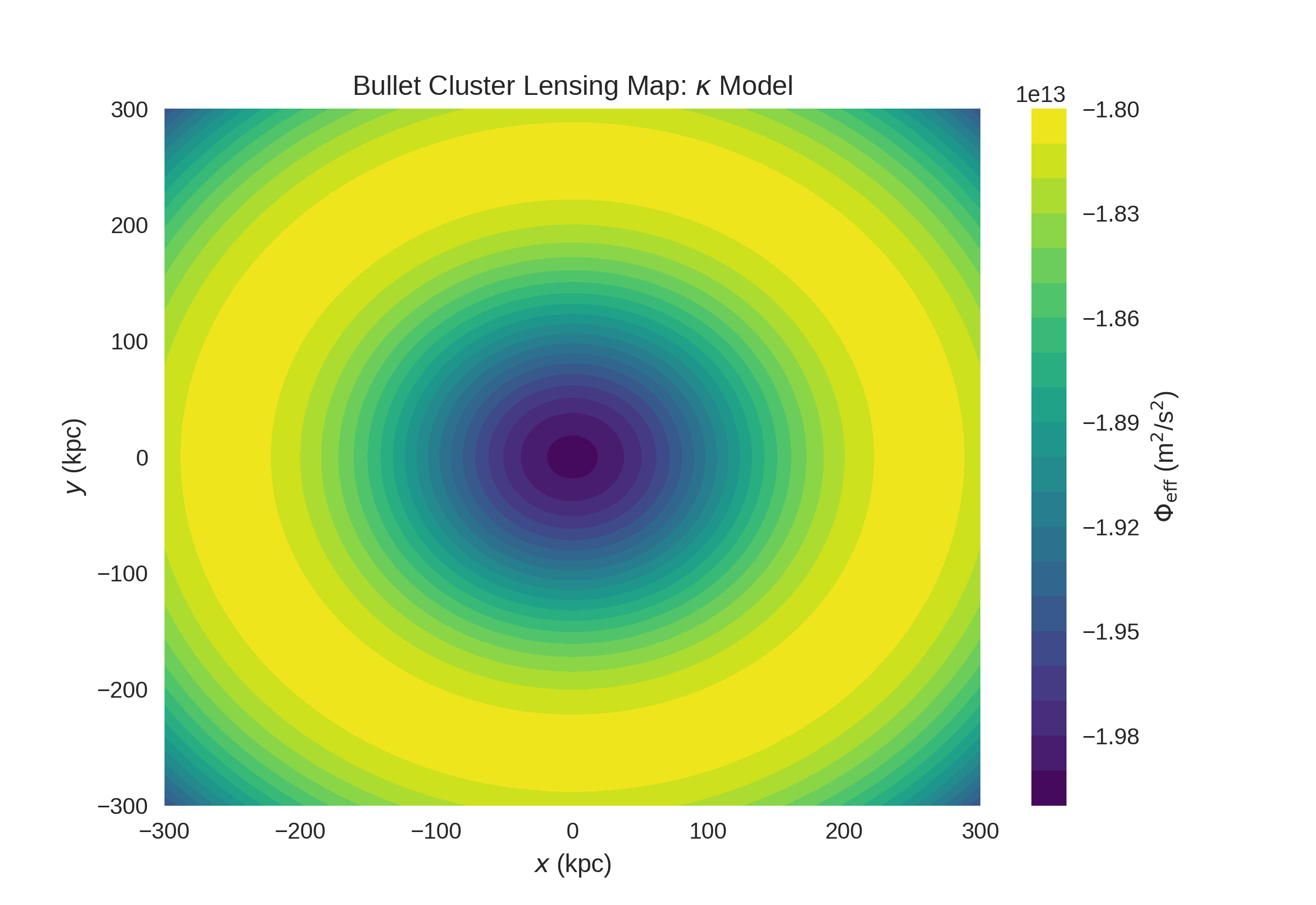
Figure 5: Bullet Cluster Lensing with Unified Model. Illustrates the 250 kpc offset, with enhanced galaxy clump potential.
Gravitational lensing in the Bullet Cluster (1E 0657-56, z≈0.296) shows a 250 kpc offset between galaxy and gas mass [Clowe2006]. The unified model modifies deflection as:
with
and
Using
At b ≈ 6.172 x 10^20m / 200kpc:
This suggests consistency with observed:
[Clowe2006].